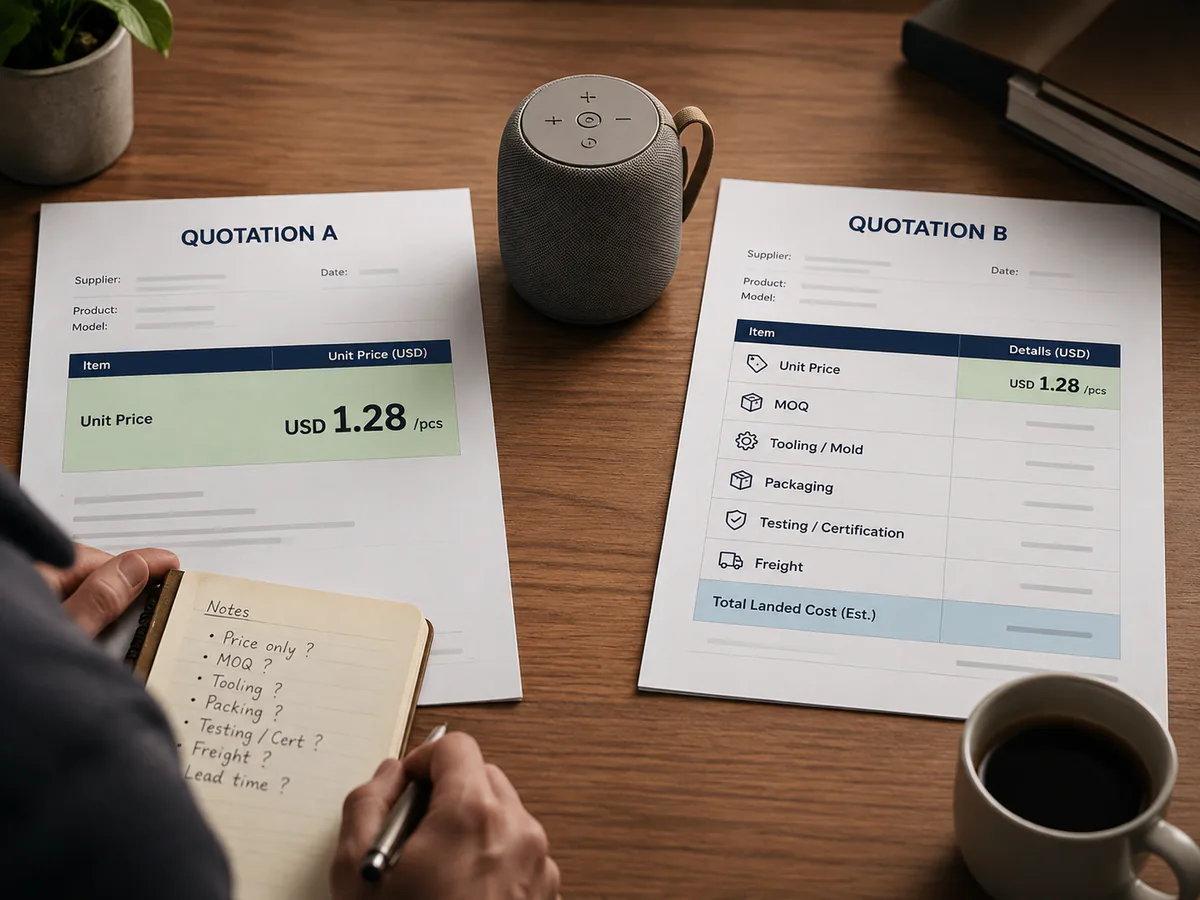
The lowest number is not always the lowest comparable offer
A low unit price is useful only when it prices the product and quantity you actually need. A supplier may quote a basic version, a higher order quantity or a price that excludes one-time and delivery-related costs.
Before ranking quotations, check what each number actually represents.
1. Check what product was priced
Confirm the:
- model, revision or part number;
- material, dimensions and finish;
- colour, accessories and configuration;
- branding, labelling and packaging;
- required process or product version.
If you sent a competitor listing, ask whether the quotation matches that exact version or a standard item from the supplier’s catalogue.
2. Check what quantity was priced
Put the MOQ and price quantity beside the unit price. A price for 5,000 units should not be compared directly with another supplier’s price for 500.
Ask for:
- MOQ;
- quantity price breaks;
- sample quantity and sample price;
- production lead time at the requested quantity;
- packaging quantity and any minimum packaging run.
A supplier may be competitive at a full production quantity but unsuitable for your first order.
3. Ask what sits outside the unit price
Common separate charges include:
- product samples and sample shipping;
- moulds, tooling, setup charges or printing plates;
- logo application, custom colour or other product changes;
- retail box, inserts, labels and export cartons;
- testing, inspection or document-related costs;
- domestic freight to the loading point;
- international freight and other delivery charges.
The exact list depends on the product and the supplier’s quotation basis. Treat each item as included, excluded or to confirm.
4. Check the commercial basis
Ask each supplier to state:
- Incoterm and named place;
- what freight or local charges are included;
- payment terms;
- quote validity;
- sample and production lead time;
- currency and tax basis, where relevant.
EXW and FOB are not the same cost basis. A quotation with an unclear delivery term should not be ranked directly against a quotation with a clearly stated Incoterm.
For destination-country duties, taxes, certification and import requirements, the buyer should obtain current advice for the specific product and destination. Mon can flag the commercial fields that need confirmation but does not provide legal or tax conclusions.
5. Follow up using the same questions
Send the same missing-field questions to each candidate. If a supplier still does not answer, keep the non-response visible rather than treating the blank as a favourable assumption.
| Field | Supplier A | Supplier B | Supplier C |
|---|---|---|---|
| Product version | Confirmed / to confirm | Confirmed / to confirm | Confirmed / to confirm |
| Price quantity | |||
| MOQ | |||
| Sample cost | |||
| Tooling or setup | |||
| Packaging | |||
| Lead time | |||
| Incoterm and place | |||
| Payment terms | |||
| Open questions |
The goal is not a perfectly filled table. It is to avoid rewarding an incomplete quotation simply because its first number looks lower.
Final check before choosing
Before you treat one quote as the best commercial option, make sure you know:
- which product and specification were priced;
- at what quantity and MOQ;
- which one-time charges apply;
- which packaging and testing items are included;
- which Incoterm and delivery basis are used;
- which questions remain unanswered.
This helps you make a more informed comparison. It does not guarantee the lowest landed cost, product quality or final project outcome.
Sources
Common questions
How are sourcing services priced?
You can choose one defined service or combine several stages. Indicative service fees are: Supplier Search & RFQ: USD 199–499 per product or closely related product family; Sample & Prototype Coordination: USD 149–399 per supplier and sample round; Production Follow-up: USD 299–799 per supplier and 30-day production period; Pre-Shipment Inspection Coordination: USD 149–399 per assignment; Complete Project Coordination: 3%–5% of purchase value, subject to an agreed minimum service fee; Equipment and vehicle projects: USD 499–1,499 initiation fee plus a 1%–3% success fee, with a minimum success fee of USD 1,000, and the initiation fee credited against the success fee. The exact scope, deliverables and service fee are confirmed in writing before work begins.
Do you guarantee supplier quality or the lowest price?
Mon helps identify relevant suppliers, organize requirements, compare quotations and coordinate agreed sourcing stages, but does not guarantee the lowest price, supplier performance, product quality, certification, delivery or final project outcome.