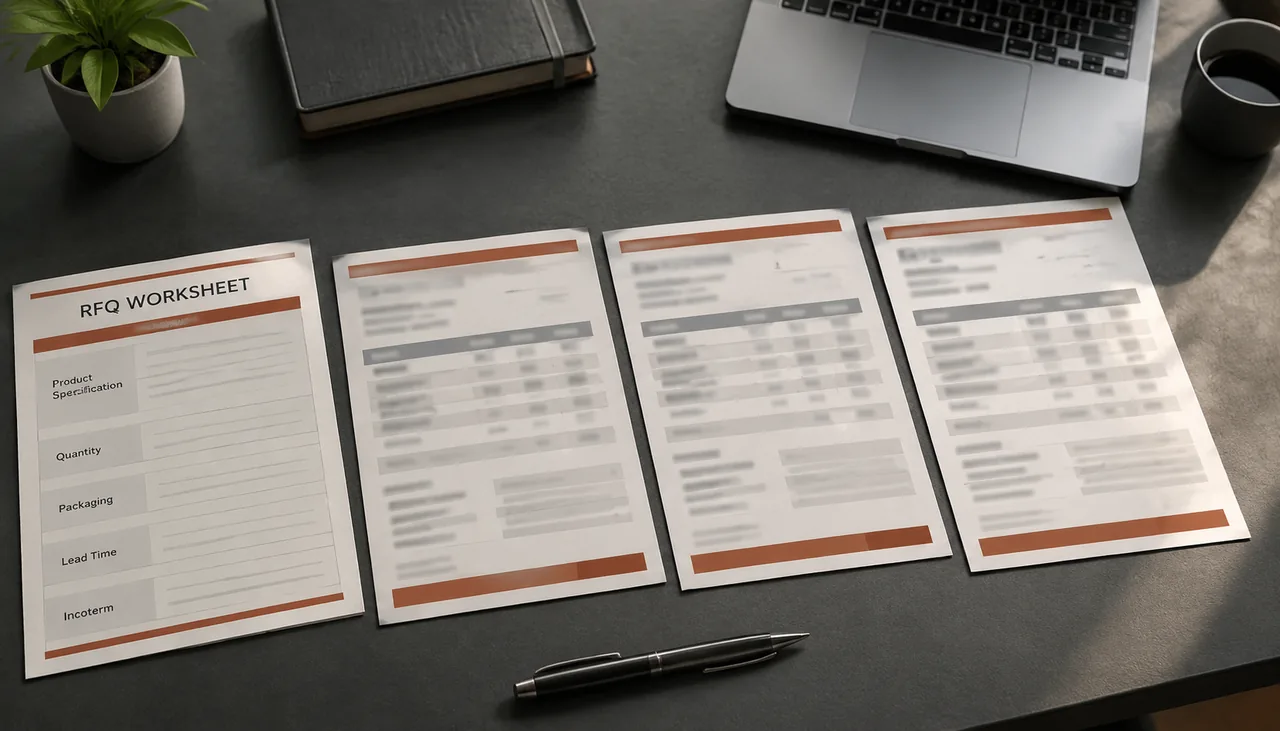
A useful RFQ makes supplier answers comparable
A China supplier RFQ should give every candidate the same product baseline, quantity scenarios and commercial questions. It should also tell suppliers how to mark exclusions, alternatives and unanswered fields.
The goal is not to make the document long. It is to reduce the number of hidden assumptions behind each price.
Use three labels while preparing it:
- required — the quotation must follow this requirement;
- preferred — explain whether the supplier can meet it and identify any effect on price or lead time;
- open to proposal — the supplier may recommend an alternative, but must describe it clearly.
1. Start with the product and its intended use
Identify the product in terms a supplier can quote, not only by a short product name. Depending on the project, include:
- product name, model, revision or drawing number;
- intended use and relevant operating conditions;
- reference drawings, photos, samples or links;
- material, dimensions, tolerances and finish;
- required functions, configuration and accessories;
- branding, labels, manuals and language requirements;
- destination market, where it affects the requested product or documents.
A reference link or photo can help a supplier understand the product category, but it does not define hidden materials, internal construction, performance or compliance requirements. List those separately when they matter.
If a detail is unknown, write open to supplier proposal rather than allowing each supplier to make a different silent assumption.
2. Separate requirements from supplier proposals
Suppliers need to know which fields are fixed and which can change. A simple requirement table helps:
| Field | Status | Buyer input | Supplier response required |
|---|---|---|---|
| Material or grade | Required | State grade or standard | Confirm or state exception |
| Finish or colour | Preferred | State target | Confirm option and cost effect |
| Component choice | Open to proposal | State performance need | Identify proposed component |
| Packaging | Required or preferred | State pack-out need | Describe included packaging |
This prevents a cheaper substitute from being mistaken for a like-for-like quotation. An alternative may be useful, but it should appear as a visible alternative.
3. Ask for the same quantity scenarios
State the quantity you expect to buy and ask every supplier for the same price breaks. For example:
- sample or prototype quantity;
- first-order quantity;
- expected repeat-order quantity;
- supplier MOQ;
- quantity per carton or other packaging multiple.
Ask the supplier to identify where MOQ constraints come from, such as a production run, purchased component, custom colour, printing or packaging order. The explanation is useful for planning, but it is still supplier-stated information until supported or tested through later work.
4. Make one-time and optional costs visible
Ask suppliers to separate the unit price from costs that do not apply equally to every order:
- sample and sample-delivery cost;
- mould, tooling, fixture or setup cost;
- printing plates, artwork or custom-colour charges;
- testing, inspection or document-related charges;
- retail packaging, labels, inserts and export cartons;
- optional accessories or spare parts;
- domestic and international freight, if requested.
For tooling, ask who owns it, where it will be held, what maintenance is included and whether replacement costs may arise. Do not assume a tooling payment automatically answers those questions.
5. Define the requested quotation basis
Ask every supplier to state:
- quotation currency;
- price quantity and MOQ;
- Incoterm and named place;
- what local transport, loading or export-related work is included;
- sample and production lead times;
- payment terms;
- quotation validity;
- estimated packed dimensions and gross weight, where available.
Incoterms allocate specified costs, tasks and risks between seller and buyer; they do not by themselves define product quality, payment timing or transfer of ownership. Use the current ICC rules and name both the rule and place—for example, FCA [named place] Incoterms® 2020—instead of asking only for an “FOB price” without a location.
The final landed cost may also involve freight, insurance, duties, taxes, brokerage and destination requirements outside the supplier’s quotation. Buyers should obtain current product- and destination-specific advice where needed.
6. Request a structured supplier reply
Give each supplier the same response table. Blank fields should stay blank or be marked to confirm; they should not be treated as included.
| RFQ field | Supplier response |
|---|---|
| Quoted product, model or revision | |
| Exceptions or proposed alternatives | |
| Price at each requested quantity | |
| MOQ and packaging multiple | |
| Sample cost and lead time | |
| Tooling or setup cost | |
| Branding and packaging included | |
| Production lead time | |
| Incoterm and named place | |
| Payment terms and quote validity | |
| Estimated packed size and weight | |
| Documents or tests offered | |
| Open questions |
Ask suppliers to attach or identify any referenced specification, drawing or quotation revision. If the product definition changes during discussion, update the RFQ revision so later prices are not compared against an older requirement set.
7. Keep claims in the right evidence state
An RFQ response helps organize a commercial comparison. It does not prove that a supplier can consistently manufacture the product or that the product meets destination requirements.
Keep important statements in one of three states:
- supplier-stated — present in the quotation, message or supplied document;
- evidence reviewed — supporting material has been examined, with its scope and limits recorded;
- still to confirm — requires a sample, technical review, current document, production evidence or independent inspection.
Mon can coordinate supplier questions, quotation clarification and comparison. Mon is not the manufacturer, exporter, inspection body or legal or tax adviser, and does not guarantee product quality, compliance, delivery or project outcome.
RFQ checklist before sending
Before sending the same RFQ to shortlisted suppliers, confirm that it includes:
- one identifiable product baseline;
- required, preferred and open-to-proposal fields;
- the same quantity and price-break request;
- separate one-time and optional costs;
- packaging, branding and document requirements;
- sample and production timing;
- Incoterm and named place;
- a structured supplier response table;
- visible exceptions, unknowns and revision control.
A disciplined RFQ will not remove every sourcing risk. It gives you a clearer starting point: suppliers are responding to the same request, and the remaining differences are easier to see before you decide what to verify next.
Sources
Common questions
How are sourcing services priced?
You can choose one defined service or combine several stages. Indicative service fees are: Supplier Search & RFQ: USD 199–499 per product or closely related product family; Sample & Prototype Coordination: USD 149–399 per supplier and sample round; Production Follow-up: USD 299–799 per supplier and 30-day production period; Pre-Shipment Inspection Coordination: USD 149–399 per assignment; Complete Project Coordination: 3%–5% of purchase value, subject to an agreed minimum service fee; Equipment and vehicle projects: USD 499–1,499 initiation fee plus a 1%–3% success fee, with a minimum success fee of USD 1,000, and the initiation fee credited against the success fee. The exact scope, deliverables and service fee are confirmed in writing before work begins.
Do you guarantee supplier quality or the lowest price?
Mon helps identify relevant suppliers, organize requirements, compare quotations and coordinate agreed sourcing stages, but does not guarantee the lowest price, supplier performance, product quality, certification, delivery or final project outcome.
Who handles manufacturer export, freight and destination-country import?
Where direct export is available, the manufacturer can export the goods or equipment directly. Mon does not act as the seller, exporter, carrier, freight forwarder or customs broker. Freight may be arranged through your chosen freight forwarder, settled in your country or included in the manufacturer’s commercial arrangement. Mon can coordinate the handover and communication when included in the agreed scope.