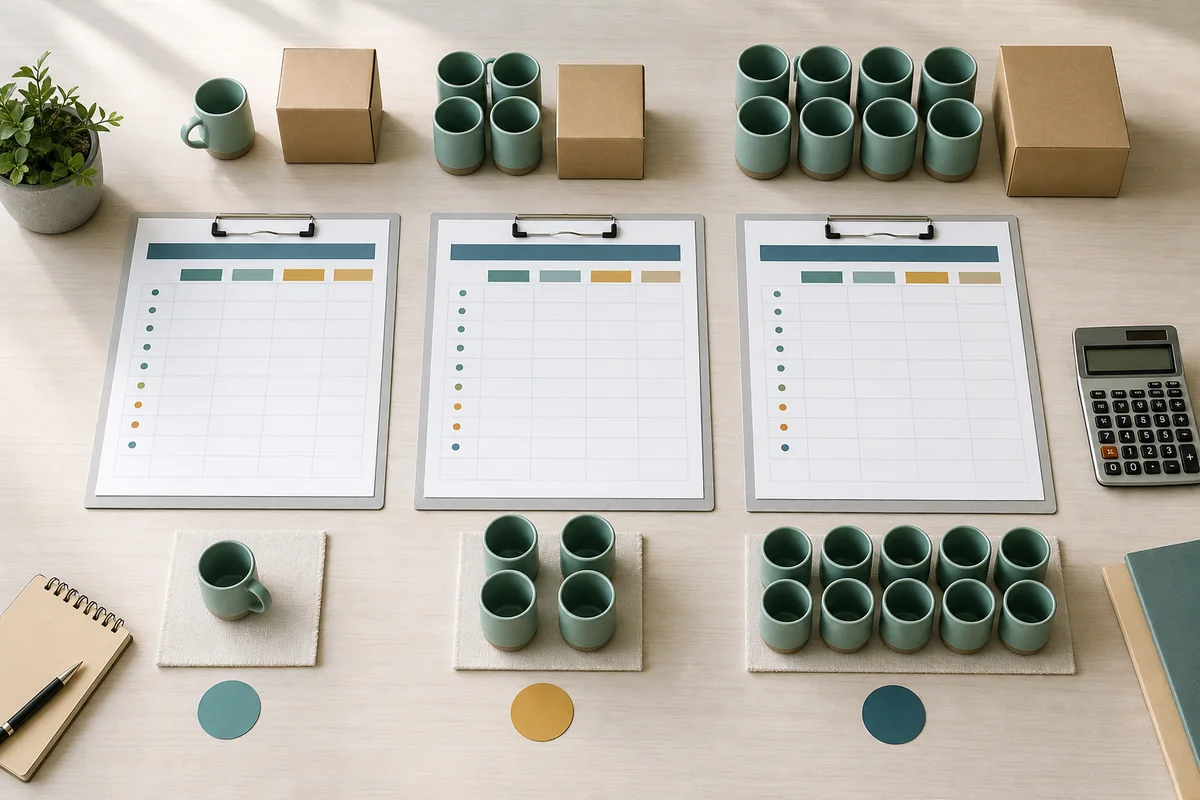
MOQ is not a comparable number by itself
One supplier may quote a minimum per colour. Another may quote a minimum for the whole order. A third may accept a small first run but charge tooling, setup or packaging costs separately.
Before choosing the lowest MOQ or the lowest unit price, put all suppliers on the same comparison basis.
1. Define what the MOQ applies to
Ask the supplier to label each minimum clearly:
- per SKU or model;
- per colour or finish;
- per material or size;
- per packaging version;
- per production run or total purchase order.
If you sell six colours, a “500-piece MOQ” could mean 500 total or 500 of each colour. Those are radically different commitments.
2. Use the same quantity tiers
Request at least three scenarios that reflect the buyer’s real decision:
| Scenario | Question answered |
|---|---|
| Pilot quantity | Can the product be tested without committing to a full run? |
| Expected first order | What will the likely launch order cost? |
| Higher quantity | Does a larger order materially change the unit economics? |
Keep the product specification, packaging and delivery basis constant across the tiers. Otherwise the apparent price break may be a different product or a different commercial offer.
3. Ask what creates the minimum
MOQ can reflect several different constraints:
- raw-material purchasing or material rolls;
- production-line changeover or setup;
- mould, tooling or print-plate economics;
- carton, label or packaging minimums;
- supplier scheduling or capacity;
- a supplier’s preferred commercial threshold.
Ask which constraint is binding and whether it applies to the first order only or every repeat order. The answer may reveal a practical adjustment, such as using standard packaging, consolidating colours or separating a tooling charge from the unit price. It does not guarantee that the supplier will reduce the minimum.
4. Separate the price components
Put these in separate columns instead of folding them into a single “landed” number:
- unit price and currency;
- tooling, setup or artwork charges;
- sample and revision charges;
- packaging and labelling;
- inspection or testing requested by the buyer;
- freight, insurance and named delivery term;
- payment schedule, quote validity and taxes or duties that remain outside the quote.
If a delivery term is used, record the named place as well. ICC’s Incoterms rules clarify tasks, costs and risks in delivery, but an Incoterm does not define product quality, payment timing, ownership transfer or every landed cost.
5. Compare commitment, not only unit price
Create a short decision table:
| Supplier | Quantity basis | Cash commitment | Open assumptions | Next question |
|---|---|---|---|---|
| A | Per colour | pilot + setup | packaging not fixed | Can standard packaging apply? |
| B | Total order | higher first order | material basis unclear | Is the material the same as A? |
| C | Per SKU | lowest unit price | MOQ exceeds forecast | Can a staged order be quoted? |
The right offer is the one whose product, quantity, timing and assumptions match your actual decision. A lower unit price can still require a larger cash commitment or leave more cost outside the quotation.
A repeatable MOQ comparison request
Ask every supplier to answer the same fields:
- MOQ by SKU, colour, material and packaging version.
- Pilot, first-order and higher-quantity prices.
- One-time tooling, setup, artwork and sample charges.
- Lead time for sample, pilot and repeat order.
- Packaging, inspection, freight and named delivery term.
- Quote validity, payment schedule and every exclusion.
- Whether the same basis applies to repeat orders.
Keep unanswered fields visible. If a supplier proposes an alternative material, pack size or quantity basis, place it in a separate row rather than silently comparing it with the requested offer.
Mon can coordinate a consistent RFQ and comparison brief across suppliers. The buyer remains responsible for forecasting, commercial approval, import costs and the final order decision.
Sources and limits
The MOQ discussion reflects the buyer-facing questions surfaced in OWA Decor’s guide. Delivery-term boundaries follow ICC’s Incoterms overview. Supplier-specific MOQ, price and timing must be confirmed in the current written quotation; this article does not forecast savings or guarantee negotiation results.
Sources
Common questions
How are sourcing services priced?
You can choose one defined service or combine several stages. Indicative service fees are: Supplier Search & RFQ: USD 199–499 per product or closely related product family; Sample & Prototype Coordination: USD 149–399 per supplier and sample round; Production Follow-up: USD 299–799 per supplier and 30-day production period; Pre-Shipment Inspection Coordination: USD 149–399 per assignment; Complete Project Coordination: 3%–5% of purchase value, subject to an agreed minimum service fee; Equipment and vehicle projects: USD 499–1,499 initiation fee plus a 1%–3% success fee, with a minimum success fee of USD 1,000, and the initiation fee credited against the success fee. The exact scope, deliverables and service fee are confirmed in writing before work begins.
What information do I need to start?
A short description and one useful reference—such as a product link, photo, model number, drawing or sample—is enough to begin the conversation. Detailed specifications, quantities, commercial requirements and confidential files can follow by email after initial contact.